


Hit a Pothole in Boston? You May Have Only 30 Days
Under Massachusetts General Laws Chapter 84, Section 18, a rider injured by a road defect must give written notice to the county, city, town, or person by law obliged to repair that road within 30 days of the crash. The notice must state the injured rider’s name, place of residence, and the time, place, and cause of the injury. A crater that throws a motorcyclist across two lanes of Dorchester Avenue triggers one of the shortest claim clocks in Massachusetts law.
If you were hurt in a Boston motorcycle crash caused by a pothole, sunken utility cover, or crumbling pavement, the 30-day clock is already running. Ballin & Associates, LLC has handled personal injury exclusively since 1981, and for over 40 years we have gone to bat for injured riders across Massachusetts. Call 508-882-2853 or contact us now for a free consultation. There is no fee unless we win.
Road defect claims are unusual because the deadline arrives long before most riders leave the hospital. Our mgl 84 15 road defect notice lawyer team handles the notice while you focus on healing. The rules below explain what the notice must say, who must receive it, and what options may remain if the deadline passed.
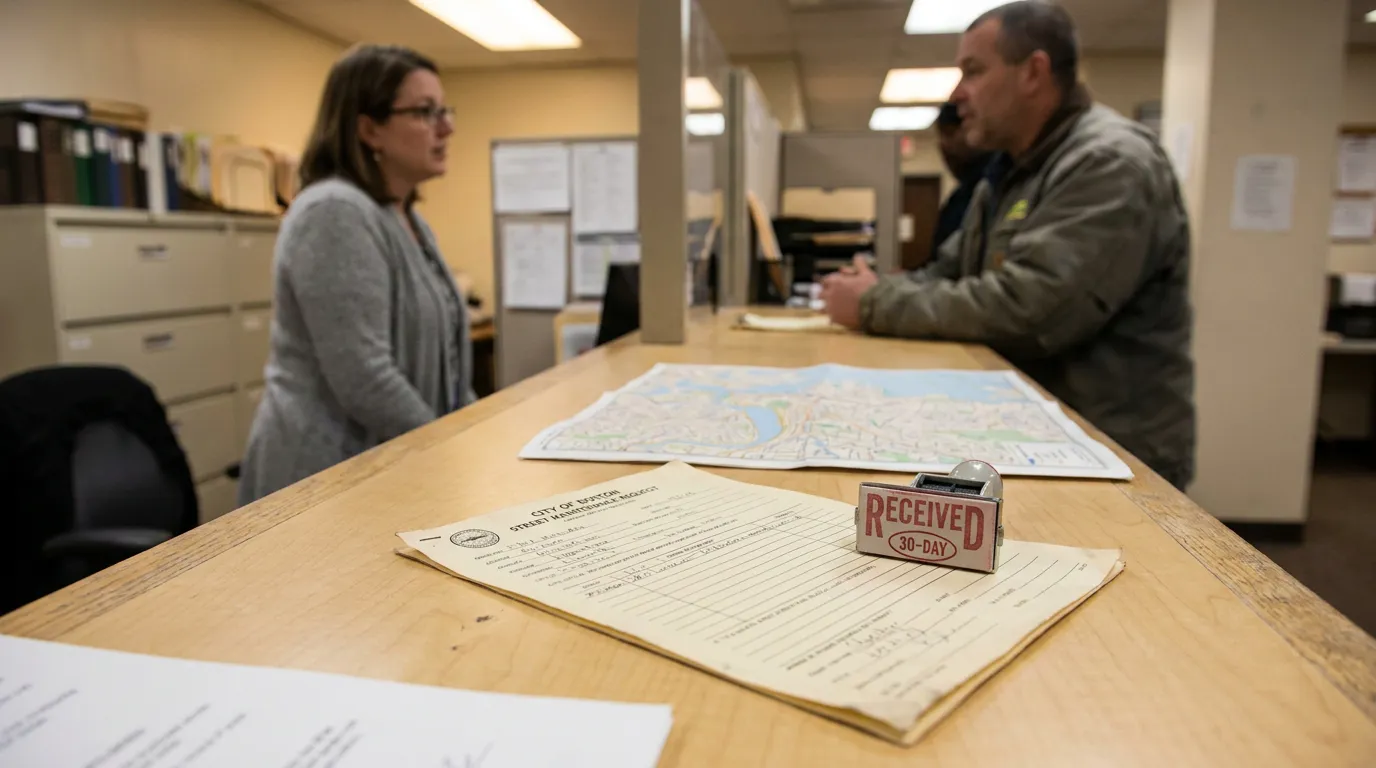
What the 30 Day Road Defect Notice Massachusetts Law Requires
A compliant notice is short, written, and specific. Under Massachusetts General Laws Chapter 84, Section 18, the notice must identify the injured person’s name and place of residence, plus the time, place, and cause of the injury. Section 19 requires it be in writing and signed by the injured person or someone on their behalf. Municipal guidance expects enough detail for the entity to investigate the site.
Defect notice filing is not a lawsuit, it preserves your right to file one. Vague descriptions like "somewhere on Blue Hill Ave" invite disputes over adequate identification, so exact cross-streets, lane position, and direction of travel matter.
\u{1F4A1} Pro Tip: Send notice by certified mail, return receipt requested, and keep a photocopy. Proof of delivery is often as important as the notice itself.
Notice Deadline Municipality Routing: Filing a Claim Against City Boston Agencies
Not every street in Boston belongs to Boston. Claims against city Boston departments go to the responsible municipal office, but state highway defects are governed by M.G.L. c. 81, § 18, which applies the same limits as c. 84, §§ 15, 18, and 19. Parkways and boulevards maintained by state agencies follow M.G.L. c. 92, § 36.
Serving the wrong entity can cost a rider the claim entirely. From our Foxborough office we serve riders throughout Boston, and knowing which agency controls a stretch of pavement is essential. When ownership is unclear, notice may be sent to multiple potentially responsible entities.
Chapter 84 Deadline vs. Filing Suit: Your Motorcycle Injury Timeline
The notice deadline and the lawsuit deadline are two different things. Riders often assume the 3-year filing window means nothing is urgent. That assumption kills valid claims.
- Day 0: The crash. Photograph the defect before it is patched.
- Day 30: Written notice must reach the responsible entity under c. 84, § 18.
- Roughly Day 35: If the entity responds within 5 days that the notice is insufficient, a corrected notice must follow forthwith under c. 84, § 20.
- Year 3: Suit must generally be brought within 3 years under c. 84, § 18 and M.G.L. c. 260, § 2A.
Different defendants carry different clocks. Claims against public entities also have presentment provisions under the Massachusetts Tort Claims Act, M.G.L. c. 258, § 4, which generally requires written presentment within 2 years. Note that for defects in public ways, chapter 84 generally supplies the exclusive remedy against municipalities. Deadlines for claims against a government entity in Boston include that separate 2-year presentment rule, distinct from the chapter 84 notice. If a hit-and-run driver was involved, M.G.L. c. 260, § 4B requires written notice to police and the Registrar within 30 days.
What You Have to Prove in a Road Defect Injury Claim
Proving the defect existed is only half the job. Under M.G.L. c. 84, § 15, a rider may recover only if the responsible entity had, or by exercising proper care should have had, reasonable notice of the defect and reasonable time to remedy it. This second concept is constructive notice, the entity should have known even without direct reports.
Documenting how long a defect existed often decides the claim. Prior 311 complaints, dated street-view imagery, weathering at pothole edges, and neighbor statements prove the hazard was not new. Liability requires both notice and a reasonable opportunity to repair before the crash.
Rider-specific hazards deserve particular attention. Sunken utility covers, unfilled trench seams, raised pavement lips, and old trolley track grooves rarely trouble cars but can destabilize motorcycles instantly. Whether a condition constitutes a legal "defect" is fact-dependent, and courts weigh the size, depth, location, and duration.
The $5,000 Cap and Why Your Case Is Usually Bigger
Massachusetts caps recovery from public entities for road defects. Under § 15, recovery is limited to no more than one-fifth of one percent of the entity’s state valuation and in no event more than $5,000. The statute bars claims where the combined vehicle and load weight exceeds 6 tons, but this has no practical effect on motorcyclists.
| Claim Path | Governing Law | Key Limit |
|---|---|---|
| Road defect vs. public entity | c. 84, §§ 15, 18 | 30-day notice; $5,000 cap |
| Negligent driver | c. 260, § 2A | 3 years to file |
| Contractor or utility | Common law negligence | No c. 84 cap |
Because the road defect statute’s damage limits are so low, the public entity is rarely the whole case. A negligent motorist who forced you toward the shoulder, a paving contractor that left an unmarked lip, or a utility that backfilled a trench poorly may face ordinary negligence liability outside that cap. We examine every avenue before assuming $5,000 is the ceiling.
Missed Notice Deadline? Read This Before You Give Up
A late or imperfect notice does not automatically end a claim. Section 18 provides that notice is not invalid for inaccuracies in name, residence, time, place, or cause where there was no intention to mislead and the party entitled to notice was not actually misled. Courts apply these provisions narrowly and fact-specifically.
There is also a correction mechanism. Under the corrected notice rule in c. 84, § 20, a defendant generally cannot rely on an omission or misstatement unless, within 5 days after receiving notice, it notified the claimant in writing that the notice was insufficient. A corrected notice given forthwith after that request has the effect of the original. Exception: if your notice does not contain either the place of residence of the person injured or the place of residence or business address of the person giving or serving the notice, that written warning is not required.
Two more situations may apply in limited circumstances. For injuries caused by snow or ice, c. 84, § 21 provides that failure to give required notice is not a defense unless the defendant proves prejudice, though the notice must state the injury was caused by snow or ice. Under M.G.L. c. 260, § 7, limitations periods can pause for minors and incapacitated persons, but courts generally decline to extend the chapter 84 notice period on that basis.
\u{1F4A1} Pro Tip: Even if you believe the deadline passed, preserve photos, receipts, and medical records. Evidence makes exception arguments possible.
Evidence to Gather in Your First 30 Days
Documentation collected in the first month carries the most weight. Public works crews often patch defects quickly, and once gone, so is your best proof.
- Exact date and time of the crash
- Precise location: street, nearest intersection, lane, direction of travel
- Photos of the defect with scale object, plus photos of motorcycle and gear
- Prior 311 or municipal complaint history for that location
- Police report number and responding officer
- Medical records, ambulance records, and treatment dates
- Repair invoices and replacement cost of damaged gear
Frequently Asked Questions
-
How long do I have to file a road defect claim in Boston after a motorcycle crash? Written notice is due within 30 days under M.G.L. c. 84, § 18, and the lawsuit must generally be brought within 3 years under that section and M.G.L. c. 260, § 2A. These are separate deadlines.
-
What happens if I missed the 30-day notice deadline in Massachusetts? Options may exist, though complete failure to give timely notice is often fatal. Section 18 excuses inaccuracies where there was no intent to mislead, § 20 provides a corrected-notice mechanism, and § 21 requires defendants in snow-and-ice cases to prove prejudice. Courts apply these provisions narrowly.
-
How much can I recover from the City of Boston for a pothole crash? Recovery under M.G.L. c. 84, § 15 is capped at no more than one-fifth of one percent of state valuation and in no event more than $5,000. Claims against negligent drivers, contractors, or utilities are governed by ordinary negligence law without that cap.
-
Who do I send the notice to if the crash was on a state highway or DCR parkway? State highway defects are governed by M.G.L. c. 81, § 18, and state-maintained parkways or boulevards follow M.G.L. c. 92, § 36. Confirming which entity maintains the road before sending notice is essential.
-
Does the road defect statute apply if a car also hit me? It can govern the public entity portion while ordinary negligence law governs the driver. Those claims run on different timelines and limits, so both should be evaluated together.
Ballin & Associates Is On Your Side
A pothole claim looks simple until you count the deadlines. Thirty days for the mgl 84 15 road defect notice, a prompt corrected notice if required, 3 years to file, and a separate clock for every other party who contributed to your injuries. Missing any one can quietly end a case that deserved to be heard.
Ballin & Associates, LLC is on your side. Our reputation was built on client referrals, not television advertising, and we have fought for injured Massachusetts riders since 1981. There is no fee unless we win. Talk to a Boston motorcycle injury lawyer today.
Disclaimer: This content is for informational purposes only and is not legal advice. Every case is unique, and results may vary. Consult an attorney about your specific circumstances.