


A new Massachusetts bill could reshape how fault is argued after an e-bike crash, especially in Boston, where bikes, scooters, cars, and pedestrians share crowded streets. On May 4, 2026, Governor Maura Healey filed the Ride Safe Act, creating a speed-based framework for e-bikes, scooters, and mopeds with clearer rules on age limits, helmets, equipment, roadway use, enforcement, and crash reporting. malegislature.gov For injured riders and families, this is both a transportation and liability story. Clearer operating rules affect how insurers, defense counsel, and courts evaluate negligence, comparative fault, and evidence needed to prove claims, including whether are personal injury settlements taxed Massachusetts depending on settlement components.
Why the Ride Safe Act matters to Massachusetts injury claims
Massachusetts already gives bicyclists broad rights to use public ways, and current law extends those same rights and duties to e-bike operators. Under General Laws chapter 85, section 11B, bicyclists may use public ways except limited-access or express highways where bicycles are prohibited. Section 11B 3/4 extends the same rights and duties to e-bike operators, except that e-bikes may not be ridden on sidewalks. section 11B
Crash cases often turn on which "rules of the road" applied at impact. Governor Healey called current rules "unclear and inconsistent" and said the proposal aims to "protect people and prevent tragedies before they happen." The bill was referred to the Massachusetts Senate Committee on Transportation; no confirmed hearing date has been established, and the timeline for committee action remains unclear. Ride Safe Act report
For plaintiffs, clearer rules cut both ways. They may help show a driver, rider, or device operator violated a defined safety requirement. But they also create new arguments from insurers about rider conduct, equipment, age restrictions, or device classification.
What the bill appears designed to clarify
The proposed law moves from marketing labels toward speed-based regulation. Lower-speed e-bikes would generally be treated like bicycles, while faster devices would face tighter restrictions, including age minimums and, in some cases, registration and insurance requirements. The proposal also emphasizes lights, reflectors, braking systems, and helmet rules for certain categories. malegislature.gov
This shift matters in litigation because misclassification is common. A product advertised as an "e-bike" may function more like a motorized bicycle or moped if it exceeds legal limits for Class 1 or Class 2 operation, changing the applicable rules and negligence arguments. Massachusetts does not recognize Class 3 or Class 4 e-bikes
What Massachusetts law says right now
Current Massachusetts guidance recognizes only Class 1 and Class 2 e-bikes. Class 1 is pedal-assist only, with motor assistance stopping above 20 mph and a motor of 750 watts or less. Class 2 is throttle-assist that also cuts out at 20 mph with the same power limit. Massachusetts does not recognize Class 3 or Class 4 e-bikes, and devices exceeding Class 1 or 2 limits may be treated as motorized bicycles with licensing and registration consequences. current law
For standard Class 1 and Class 2 e-bikes, no license, permit, or registration is required. But rules tighten quickly once a machine falls outside those categories, a distinction that can become central after a serious crash, particularly when the defense claims the injured person used a modified or illegally powerful device. longmeadowma.gov
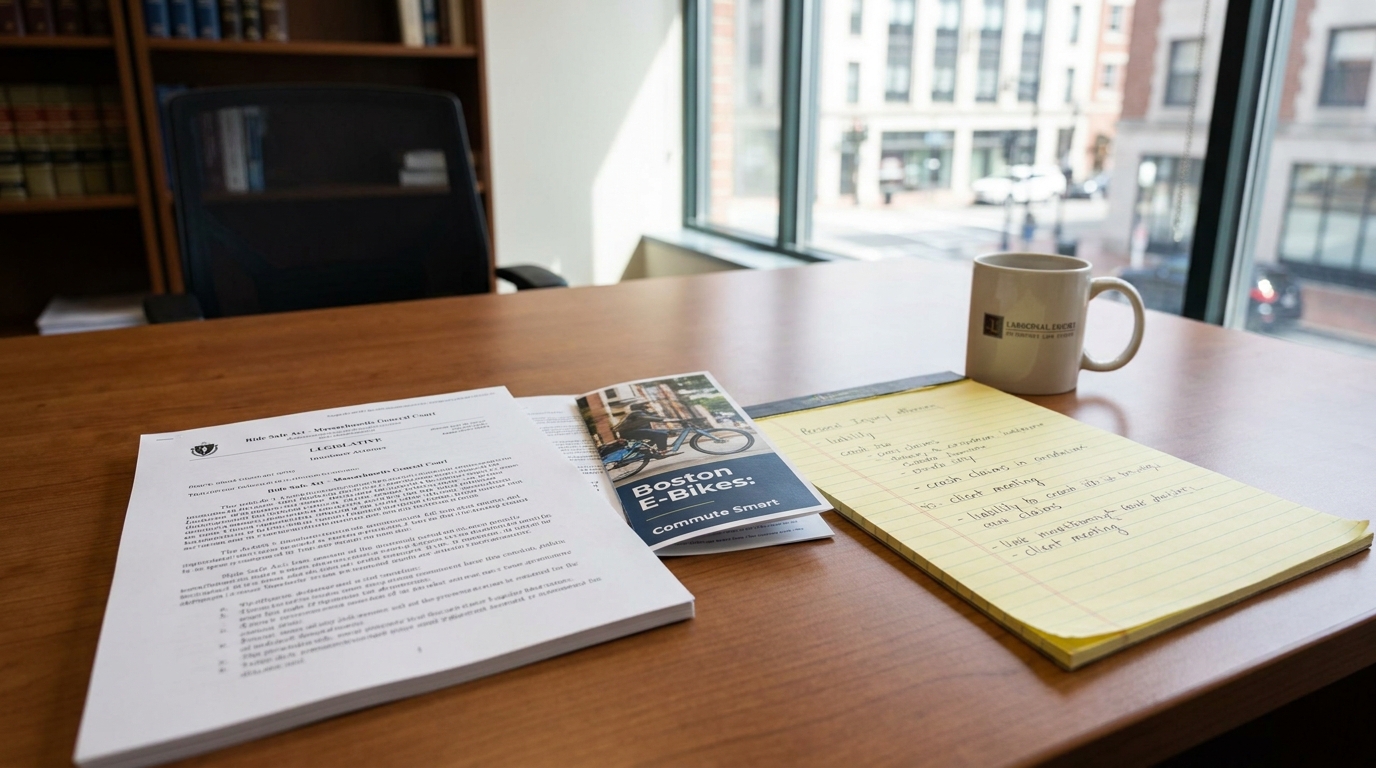
A Boston crash scenario that shows why these changes matter
Imagine a commuter riding an e-bike near Back Bay when a turning driver cuts across a bike lane, causing a collision. The rider suffers a fractured wrist, concussion, and weeks of lost income. The driver’s insurer argues the rider was partially at fault because the bike was traveling too fast, lacked required equipment, and may not have qualified as a lawful e-bike.
Legal uncertainty complicates that factual fight. If the device falls within Class 1 or Class 2 limits, the rider may argue they had the same roadway rights as a bicycle operator. If the device was modified or exceeded legal limits, the defense may argue a different statutory framework applies and use that to challenge fault, credibility, and damages. malegislature.gov
The same scenario raises compensation questions injured people commonly research. Someone dealing with medical bills and wage loss may ask whether are personal injury settlements taxed Massachusetts has a simple answer. Tax treatment depends on what the settlement pays for, so settlement components matter significantly.
Comparative fault remains one of the biggest issues in e-bike injury cases
Massachusetts follows a modified comparative negligence system, and that rule will continue to matter whether or not the Ride Safe Act becomes law. Massachusetts is a modified comparative negligence state with a 51% bar under General Laws chapter 231, section 85. An injured person may recover damages if their negligence was not greater than the opposing party’s total negligence, but any recovery is reduced in proportion to the plaintiff’s share of fault. modified comparative negligence state with a 51% bar
This framework is especially important in mixed-fault vehicle and e-bike crashes. Insurance carriers often try to shift blame onto the injured rider by pointing to lane position, speed, visibility, signaling, helmet use, or alleged violations of local riding rules to reduce damages or push the plaintiff over the comparative-fault threshold.
Important protections riders and parents should know
Massachusetts law includes plaintiff-protective language that is easy to miss. Under chapter 85, section 11B, a violation of the child passenger and helmet provisions in clause (ii) or (iii) may not be used as evidence of contributory negligence in a civil action. The statute also states that a violation of section 11B by a minor under eighteen does not affect any civil right or liability. malegislature.gov
These provisions can matter significantly in child injury cases. If a child or teen is hurt in a Boston-area bicycle or e-bike-related collision, the defense may still dispute liability on other grounds, but these statutory protections limit certain arguments that would otherwise diminish or defeat a claim.
Are personal injury settlements taxed Massachusetts after an e-bike or car crash?
This is one of the most common settlement questions, becoming more urgent after a serious injury case moves toward resolution. The question are personal injury settlements taxed Massachusetts usually cannot be answered in one sentence because settlement proceeds may include different categories of damages. Whether amounts are tied to physical injuries, lost wages, emotional distress, interest, or other categories can affect tax treatment.
For injured people, the better approach is to separate liability and allocation. First, your case must establish negligence, causation, and damages. Then, if the case resolves, the settlement language and damage nature can matter when evaluating tax implications. Because tax treatment is fact-specific, avoid relying on generalized online answers.
Legal documentation matters significantly. Medical records, wage-loss proof, and clear damage categories help support both the injury claim and later discussions about what the settlement represents. For broader background on collision claims, Ballin Law’s page on motor vehicle accidents provides additional context for how injury cases are investigated and valued.
Evidence will matter even more if enforcement rules tighten
One overlooked feature of the Ride Safe Act is its focus on enforcement and crash reporting. The bill would give police clearer authority to stop and penalize unsafe behavior, including use of modified or illegally powerful machines, and would improve crash data collection even when no motor vehicle is involved. Ride Safe Act report
For an injured rider, better documentation can be helpful, but only if key evidence is preserved early. In many e-bike cases, the device itself is evidence. So are app settings, speed modifications, purchase records, helmet condition, photographs, lighting equipment, surveillance video, and witness statements.
After any serious collision, practical first steps often include:
- Getting prompt medical care and following up consistently
- Preserving the bike or e-bike without repairs or alterations
- Photographing the scene, injuries, and equipment
- Requesting the police report and identifying witnesses
- Keeping receipts and wage-loss records
- Avoiding casual statements to insurers before facts are clear
These steps can materially affect claim strength. Readers can review these Massachusetts bicycle laws for current riding framework, since e-bike rights and duties often build on bicycle statutes.
How Does This Impact Me?
What does the Ride Safe Act mean for my existing injury claim?
If your crash already happened, the law in effect on the collision date usually matters most. A newly filed bill does not automatically rewrite the rules for a past crash, but it can influence how lawyers, insurers, and courts think about safety concerns. If the case involves disputed device classification, current statutes and the machine’s speed and power remain critical. malegislature.gov
Can the other side say I was partly at fault for riding an e-bike?
Yes, comparative negligence is a common defense in Massachusetts injury cases. A plaintiff may still recover if they were not more than 50% at fault, though damages are reduced by their share of fault. Evidence about roadway position, visibility, speed, device type, and driver conduct all become important. comparative negligence rule
If my child was not wearing a helmet, does that destroy the claim?
Not necessarily. Section 11B states that violations of the helmet rule for riders age 16 and under may not be used as evidence of contributory negligence in a civil action. The same section also says a minor’s violation does not affect civil rights or liability. Section 11B
Does this change the deadline to file a lawsuit?
This bill does not appear to change the ordinary negligence deadline. In Massachusetts injury matters, filing deadlines remain highly important. Government claim procedures can involve different and shorter administrative deadlines than ordinary civil suits, so do not assume one timeline covers every defendant or claim.
What should I do if I’m worried about both fault and settlement taxes?
Start by documenting the injury claim thoroughly and keeping records that show what losses you suffered. Questions about tax treatment often become more meaningful after there is a clear record of medical damages, lost earnings, and other case components. For current public reporting, readers can review the recent Ride Safe Act report and the Legislature’s bill page. malegislature.gov
What Boston riders and injured families should take from this now
The most important takeaway is that Massachusetts is trying to define micromobility more clearly at the exact moment these crashes are becoming harder to categorize. The Ride Safe Act, filed on May 4, 2026, would sort devices by speed, tighten requirements for faster machines, and strengthen rules around equipment, helmets, enforcement, and crash data collection. malegislature.gov
Compensation questions should be asked carefully and in context. If you are researching both liability and damages, including whether are personal injury settlements taxed Massachusetts, remember that fault issues, statutory protections, and settlement structure can all matter. No article can substitute for advice on the facts of a specific crash.
If you have questions about how a recent crash, an e-bike classification dispute, or settlement issues may affect your situation, Ballin & Associates, LLC may be able to help you understand the next steps. You can call 508-882-2853 or contact us today to request more information.