


What 49 CFR 393.75 Requires & Why a Worn Steer Tire Changes Your Case
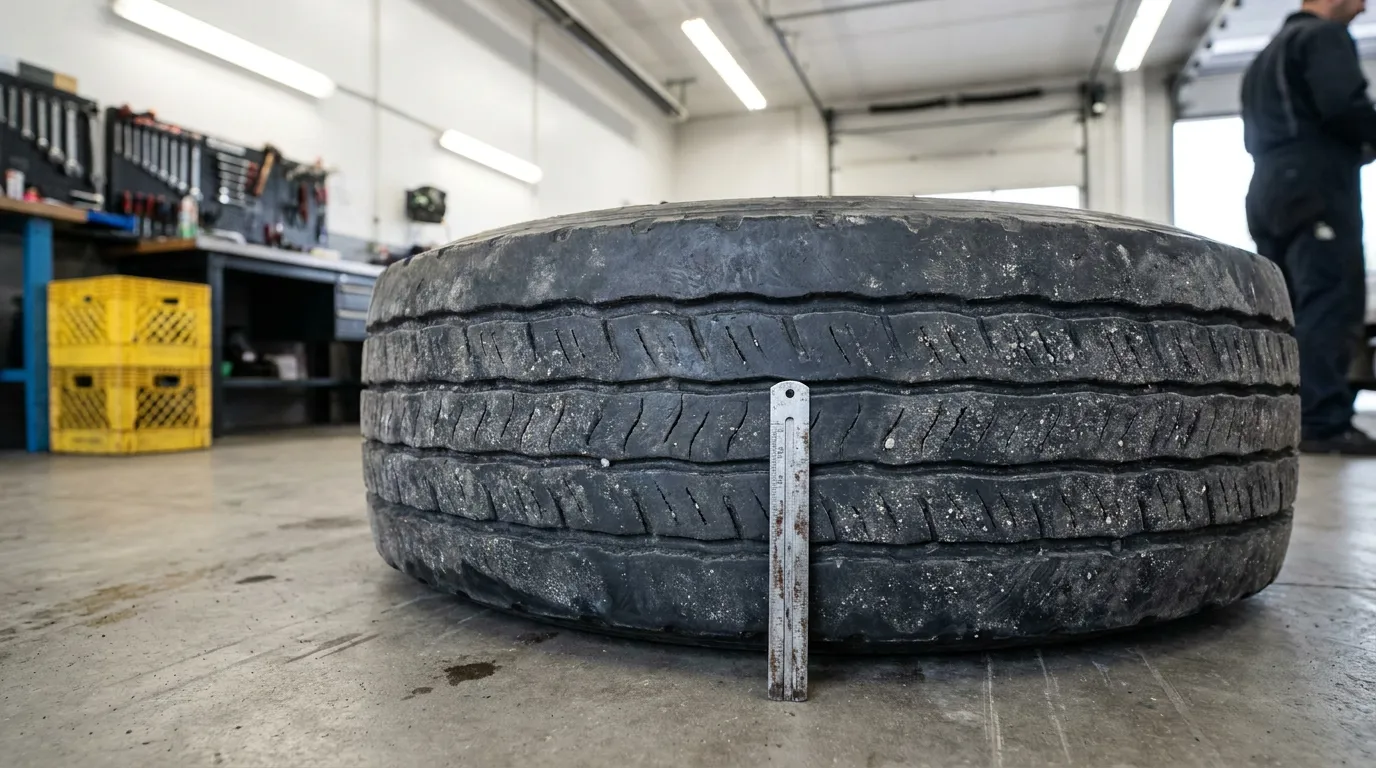
Federal law requires at least 4/32 inch of tread on the front (steer) tires of a truck, truck tractor, or bus, measured at any point on a major tread groove. All other tires must carry at least 2/32 inch. In a Boston blowout claim, a steer tire measured below 4/32 inch is evidence the trucking company put an unsafe rig on I-93, the Mass Pike, or Route 128. That measurement often anchors the entire 49 CFR 393.75 tire blowout liability analysis.
If you or a loved one has been hurt when a truck tire failed on a Massachusetts highway, the tread number on that casing may be the most important measurement in your case. Ballin & Associates, LLC has handled personal injury matters exclusively since 1981, and our 49 cfr 393.75 tire blowout liability lawyer team offers a free consultation with no fee unless we win. Call 508-882-2853 or reach our team online today.
The 4/32-Inch Steer Tire Rule, in Plain English
The steer axle gets the stricter standard because it controls the truck. When a drive or trailer tire fails, the driver generally keeps steering. When a front tire fails, the rig can pull hard across a lane in under a second. The federal truck tire tread standard sets a steer tire minimum depth of 4/32 inch while allowing 2/32 inch elsewhere (49 CFR 393.75(b)-(c)). A steer axle tire failure at highway speed is often a loss-of-control event, not just a flat.
| Tire Position | Federal Minimum Tread Depth | Authority |
|---|---|---|
| Front (steer) tires | 4/32 inch | 49 CFR 393.75(b) |
| Drive and trailer tires | 2/32 inch | 49 CFR 393.75(c) |
Tread Depth Isn’t the Only Way a Tire Violates the Rule
A tire can meet the 4/32 inch tread requirement and still be illegal. The truck tire inspection standard in 49 CFR 393.75(a)(1)-(4) bars operation with:
- Body ply or belt material exposed through the tread or sidewall
- Tread or sidewall separation
- A flat tire or an audible air leak
- A cut deep enough to expose ply or belt material
A reading of 5/32 inch does not end the inquiry. Scene photographs of the casing often reveal these conditions better than any later report.
Regrooved & Retreaded Tires on the Steer Axle
Steer-axle maintenance is where cost-cutting shows up in the records. Regrooved tires with load-carrying capacity equal to or greater than 4,920 pounds may not be used on front wheels of a truck or truck tractor, and buses may not run regrooved, recapped, or retreaded front tires (49 CFR 393.75(d)-(e)). We review tire purchase invoices and casing markings to see what was actually mounted.
Where the Tread Gets Measured: The Detail Defense Experts Fight Over
The regulation specifies where the gauge goes. Measurements must be taken in a major tread groove, not where tie bars, humps, or fillets are located (49 CFR 393.75(b)-(c)). Those raised features sit inside the groove and read shallower than the surrounding rubber, understating usable tread.
Defense re-measurements often happen weeks later, on a tire that has been moved, mounted, or stored. Accident reconstructionists document gauge placement, groove selection, and multiple points around the circumference. Good tread measurement evidence is photographed and witnessed, not recited from memory.
💡 Pro Tip: If you photographed the truck at the scene, keep the original files with their timestamps intact. Compressed copies sent by text can lose the metadata that makes an image useful later.
Massachusetts Law: What a Tread Violation Proves in a Boston Case
A tread depth violation in Boston is powerful proof, but Massachusetts does not treat it as an automatic win. Federal rules set the safety benchmark. State law decides what that benchmark does inside a courtroom.
It’s Illegal in Massachusetts to Drive, or Send Out, a Truck on Bad Tires
The Commonwealth reaches both the driver and the company. Under Massachusetts tire operating law, no person who knows a tire fails to meet minimum standards may operate that vehicle on any way, and no owner who knows of the defect may permit it to be operated (M.G.L. c. 90, § 7Q). The statute requires proof of knowledge, so inspection and maintenance records matter. That second clause puts the fleet owner and motor carrier squarely in the case, not just the driver.
A Violation Is Strong Evidence of Negligence, Not an Automatic Win
Massachusetts does not follow negligence per se. Under Massachusetts common law, a defendant’s violation of a safety statute or regulation is evidence of negligence that a jury may weigh, not conclusive proof of it. The comparative negligence statute provides that a plaintiff’s violation "shall be considered as evidence of negligence" and does not by itself bar recovery (M.G.L. c. 231, § 85). A plaintiff must still prove that the violation caused the crash and the injuries.
You Are Presumed Careful; They Have to Prove Otherwise
Massachusetts law starts from the assumption that you were being careful. Under M.G.L. c. 231, § 85, an injured person is presumed to have been in the exercise of due care, and the party claiming your negligence carries the burden of proving it. The Commonwealth uses modified comparative fault: recovery continues as long as your share of negligence is not greater than the total attributable to the defendants, with damages reduced in proportion to your share.
Who We Hold Accountable After a Boston Steer Tire Blowout
A blowout case rarely involves one responsible party. Responsibility may extend to the driver who signed the pre-trip inspection, the motor carrier that dispatched the rig, the outside maintenance vendor that serviced the axle, the shipper that overloaded it, and sometimes the tire manufacturer. A motor carrier may be responsible for its drivers’ conduct and for its own negligent maintenance, hiring, or supervision.
The Evidence That Disappears First, and How We Lock It Down
The failed tire is the single most perishable piece of proof. Casings get scrapped. Trucks get repaired and returned to service. We move quickly to send preservation letters and secure:
- The failed tire and casing, held in its post-crash condition
- Pre-trip and post-trip driver vehicle inspection reports (DVIRs)
- Maintenance logs, work orders, and tire purchase invoices
- Roadside inspection and safety history for the truck and carrier
- Black box and engine control module data
- Weight tickets, bills of lading, and dashcam footage
Understanding how Massachusetts commercial vehicle inspection requirements work explains why an inspection report that says "no defects" can itself become evidence when the tire tells a different story.
Overload & Speed Rating: The Other Half of the Tire File
Tread depth is only part of the tire story. Federal rules also restrict operating a tire above its speed rating or beyond the load capacity marked on the sidewall (49 CFR 393.75(f)-(h)). Massachusetts separately limits vehicle and axle weights on public ways (M.G.L. c. 90, § 19A et seq.). Heat builds when a worn tire carries too much weight at highway speed. That combination is a recognized path to steer axle tire failure, and weight tickets sometimes reveal it.
How Trucking Insurers Argue Around a Bald Steer Tire
Adjusters have a short list of blowout defenses:
- "Road hazard": debris or a pothole caused it, so nobody is at fault
- "Sudden emergency": the driver reacted reasonably to an unforeseeable event
- "Unavoidable accident": tires simply fail sometimes
- "You were following too closely," shifting fault onto you
- A quick settlement offer made before the tire is ever measured
Each can be tested against the maintenance file and the tread reading. A road hazard defense is harder to sustain when the tire was already below the federal minimum.
Boston & the Commonwealth: Where These Blowouts Happen
Heavy truck traffic in Greater Boston concentrates on a handful of corridors. I-93, I-90 and the Mass Pike, Route 128 and I-95, and the Southeast Expressway carry constant tractor-trailer volume. Stop-and-go loading followed by sustained highway speed is hard on front tires.
Frequently Asked Questions
-
What is the minimum tread depth for a semi-truck steer tire?
Federal law requires at least 4/32 inch of tread on the front tires of a truck, truck tractor, or bus, measured at any point on a major tread groove (49 CFR 393.75(b)). All other tires require at least 2/32 inch. Measurements may not be taken at tie bars, humps, or fillets. -
Is a trucking company automatically liable if a steer tire was below 4/32 inch in Massachusetts?
No. Massachusetts does not apply negligence per se; a violation is evidence of negligence that the jury weighs (M.G.L. c. 231, § 85). Causation must still be proven. The reading is strong leverage, but maintenance records and reconstruction evidence usually carry the claim. -
Can I still recover if the insurance company says I was partly at fault for the blowout crash?
Generally yes, as long as your share of negligence is not greater than the total attributable to the defendants (M.G.L. c. 231, § 85). Damages are reduced in proportion to your share. The party asserting your fault carries the burden of proving it, and you are presumed to have exercised due care. -
What evidence proves a steer tire was worn before a Boston truck blowout?
The casing itself, measured properly, is the core proof. Supporting records include pre-trip DVIRs, maintenance and tire purchase invoices, roadside inspection history, weight tickets, and black box data. Preservation letters sent quickly help keep those items from disappearing. -
Does Massachusetts law reach the trucking company or only the driver?
Both. No owner who knows a tire fails to meet minimum standards may permit the vehicle to be operated on any way (M.G.L. c. 90, § 7Q), and a carrier may also be liable for its own negligent maintenance or for its driver’s conduct.
Talk With a Boston Truck Crash Attorney About Your Blowout Claim
A worn steer tire is often not bad luck. It can reflect a maintenance decision, and Massachusetts law lets injured people examine that decision. Building 49 CFR 393.75 tire blowout liability into a claim takes fast evidence preservation, correct measurement of the casing, and accurate use of the Commonwealth’s negligence rules.
Ballin Law is ready to fight for your rights and secure your future. We have focused on personal injury exclusively for more than 40 years, and every case begins with a free consultation, with no fee unless we win. Learn more about our firm and start your truck injury case today. Nothing on this site should be taken as legal advice for any individual case or situation.
Disclaimer: This content is for informational purposes only and is not legal advice. Every case is unique, and results may vary. Consult an attorney about your specific circumstances.